Calisthenics
Calisthenics is a type of resistance training that relies entirely on your own body weight to perform full-body exercises with little to no equipment, improving strength, flexibility, endurance and coordination. In a way, calisthenics combines strength training with a heart-pumping cardiovascular workout. By working on calisthenics consistently, you can build up your endurance and build muscle over longer periods.
The Benefits of Calisthenics
One of the largest benefits of calisthenics is there is no need for a well-equipped gym or a bunch of machines in a workout studio to do these exercises. The only things needed are your body, time, and enough space to move freely without risk of injury. Once you get into calisthenics, there are other benefits, too, including:
- A flexible exercise routine. Calisthenics involves a variety of exercises that count as high-intensity interval training (HIIT), providing the same cardio benefits as interval running, sprinting or walking on a treadmill.
- Improved strength. Calisthenics are functional exercises that directly impact your ability to do everyday tasks because you’re working on improving your mobility, balance, coordination and flexibility.
- Better posture and a healthier weight. Building muscle through strength training exercises like calisthenics can help you lose unwanted pounds and maintain your weight management goals.
Calisthenics Workout Routine
To begin, try to do all of the following exercises at least once, with 30 to 45 seconds between each set.
Once you get the hang of it, feel free to repeat the entire routine again, with a couple minutes of rest in between each round.
Beginners might start with three sets of five reps of each exercise, while others might do three sets of 15 reps. Aim for two to four days of strength training per week, with a day of rest in between the sessions to give your muscles time to repair and get stronger.
Lingo
- Reps, or “repetitions,” refer to how many times you perform an individual exercise. One squat is one rep, while 10 squats are 10 reps and so on.
- Sets are a group of reps that are performed without a break in between. If a workout routine calls for 10 reps and three sets of 10, for example, do 10 of that exercise, then take a break, then do 10 more, then take a break, and then do the last 10.
- Rests are short breaks between sets. Down some water, catch your breath and start the next set.
Best strength / body‑weight moves for bones
These combine weight‑bearing with muscle‑strengthening, which is ideal for bone density.
Focus on:
- Squats to chair: feet hip‑width, sit back to a chair, stand up; targets hips, thighs, spine. Progress by lowering chair or holding light weights.
- Forward step‑ups: step onto a stair or low step, then down; trains hip and thigh, mimics stairs in real life.
- Lunges or split squats: shorter stance if balance is an issue; builds strength around hips and knees.
- Wall push‑ups / counter push‑ups: load wrists, arms, shoulders, and upper spine safely.
- Standing calf raises: rise onto toes while holding a counter for balance; good for lower leg bones and balance.
For each: 2–3 sets of 8–15 reps, 2–3 non‑consecutive days per week.
Bodyweight strength (no equipment)
Your body is the load; joints are taking meaningful force.
- Push‑ups (wall, incline, floor)
- Planks and side planks
- Step‑ups onto a box or sturdy step
- Hip thrusts / glute bridges
- Chair squats or sit‑to‑stands
Action tip: If the last 2–3 reps feel hard but doable, it’s strength work.
Beginner “Mechanical Signal” Routine
To tell your bones they need that calcium, you have to apply “impact” or “loading.” Perform these 2–3 times a week.
Calisthenics Videos:
Beginner At Home Calisthenics Workout – No Equipment, 20 Minutes, Full Body – **please use a mat or pad under your knees, she doesn’t in this video ** – by Lucy Lismore
Strength exercises you can do at home – Exercise physiologist demonstrates how to do strength training, 10 strength exercises from the comfort of your own home – by British Heart Foundation
20 Minute Full Body Strength Workout (No Equipment/No Repeat) – This is a great workout for beginners who want to build good overall strength with basic bodyweight exercises – by Juice & Toya
30 Minute Full Body Strength Workout [No Equipment + Modifications] – full body flow is has a mixture of active movements and isometric holds to help you maximize strength and stability – by Juice & Toya
30 Min Beginner Full Body CALISTHENICS Workout at Home | No Repeat – The workout is already beginner-friendly, and during the 20-second rest even easier modifications for selected exercises are demonstrated – by Lucie Braunschweig
CALISTHENICS Full Body BEGINNER At Home Workout | 30 Min, No Repeat – no equipment needed except a mat and a chair or sofa! This session is designed as an intermediate-level bodyweight workout, but with beginner-friendly modifications included for nearly every exercise – by Lucie Braunschweig
Full Body Calisthenics Workout – Follow Along At Home – Beginner and Intermediate, 15 Minutes – Exercises in Workout: Inchworms, Reverse Alternating Lunge, Wall Sit, Table Top, Arch Body Hold, Plank – by Lucy Lismore
30 minute full body calisthenics home workout – No Repeats | No Equipment – utilizing just our bodyweight to test your strength and balance – by Olivia Lawson
25 MIN FULL BODY CALISTHENICS WORKOUT – Bodyweight Only, No Equipment – inspired workout uses just your bodyweight to help you build strength, improve control, and feel more TONED – by growingannanas
1 Hour ISOMETRIC & DYNAMIC FULL BODY WORKOUT – begin with lower body for 20 minutes, upper body for 20 minutes and core & ab for 20 minutes to complete a full body workout of 1 hour – by Caroline Girvan
1. The “Heel Drop” (Zero Equipment)
How: Stand tall, lift your heels off the ground, then drop them back down firmly (but not painfully).
Why: This creates a small “jarring” vibration that travels up the leg bones, signaling them to strengthen.
Repetition: 20 drops.
2. Sit-to-Stand (The Functional Squat)
How: Sit on a sturdy chair, then stand up without using your hands. Sit back down slowly.
Why: This loads the hip joints and femur, which are the most common sites for age-related “loss.”
Repetition: 3 sets of 10.
3. Wall Push-Ups
How: Stand arm’s length from a wall, lean in, and push back.
Why: This places weight on the bones of the wrists and forearms, another high-risk area for density loss.
Repetition: 3 sets of 12.
Standing Exercises To Strengthen Your Core
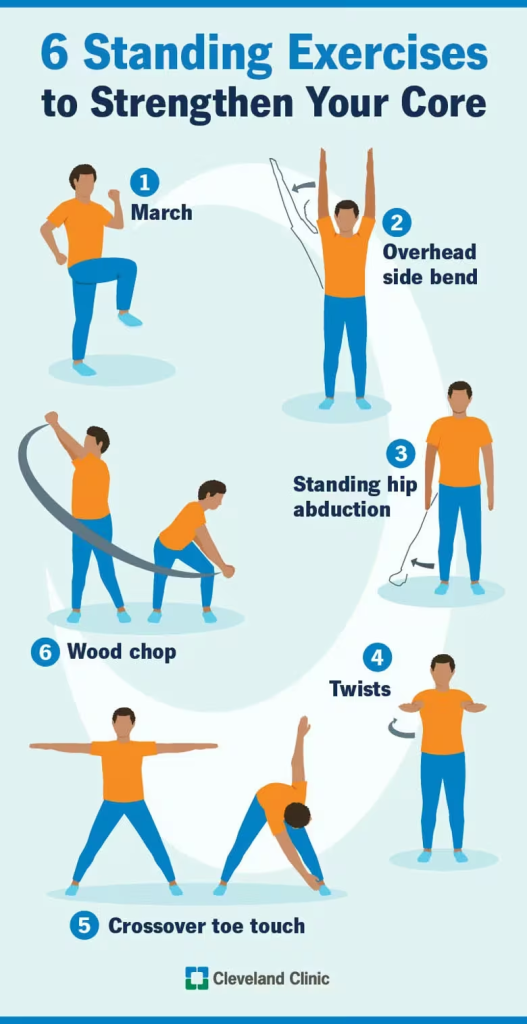
1. March. Targets: Rectus abdominis, transverse abdominis, erector spinae and hip flexors
- Start in a standing position with your feet about hip-width apart.
- In an exaggerated marching motion, bring your right knee straight up and move it toward your chest until your thigh is parallel to the floor.
- Return to a standing position and repeat the motion with your left leg for one set.
- Continue for 10 to 15 sets.
Pro tip: Want to make the march more challenging? Then add a “twist” to your motion by moving your right knee toward your left side when you raise it. (Your left knee would go toward your right side.)
2. Overhead Side Bend. Targets: External and internal obliques, quadratus lumborum, deltoids and erector spinae
- Stand tall with your feet hip-width apart.
- Extend your arms up, palms facing each other (as if you’re signaling a touchdown).
- Tilt to the right while keeping your torso and arms straight. You’ll feel a stretch on the left side of your body as your waist bends to the right.
- Return to the center position and repeat the motion to the left for one set.
- Continue for 10 to 15 sets.
3. Standing Hip Abduction. Targets: Rectus abdominis, transverse abdominis, erector spinae, glutes and hamstrings
- Begin in an upright position with your feet about hip-width apart.
- Kick your right leg out to the side, keeping it straight. Your toes should point forward during the motion as your leg scissors out and back. “Keep the movement smooth and consistent both ways,” instructs Lawton.
- Repeat 10 to 15 times and then do the same with your left leg.
4. Twists. Targets: Internal and external obliques, rectus abdominis, transverse abdominis and erector spinae
- Stand and plant your feet about shoulder-width apart.
- Extend your arms straight out in front of you, parallel to the floor.
- Rotate your upper body to the right from your midsection while trying to keep your hips facing forward.
- Return to the center. Then, rotate to the left to complete one set.
- Repeat 10 times.
5. Crossover Toe Touch. Targets: Internal and external obliques, rectus abdominis, transverse abdominis, erector spinae, hamstrings and glutes
- Begin in a standing position with your feet slightly wider than shoulder-width apart.
- Extend your arms out to your side, as if forming the letter T.
- Rotate your torso to the right while reaching your left hand down to tap your right foot. Most of the movement should be in your core, not your legs.
- Return to the T position and repeat the motion in the opposite direction (with your right hand touching your left foot) to complete a full set.
- Repeat 10 to 15 times.
6. Wood Chop. Targets: Internal and external obliques, rectus abdominis, transverse abdominis, erector spinae, deltoids and latissimus dorsi
- Stand with your feet positioned shoulder-width apart.
- Clasp your hands together (as if holding an ax) and bring them up over your head to the right. Your torso will rotate slightly to the right as you twist.
- Bring your hands down and to the left in a “chopping” motion that swings across your chest toward your left leg. Rotate your torso to the left as you take the swing. Bend your knees slightly and pivot your feet, too.
- Return to the raised position. Take 10 chops.
- Repeat with your hands, starting to the left and swinging to the right.
To Help get Started, a Full-Body Calisthenics Workout Routine – Three Sets of:
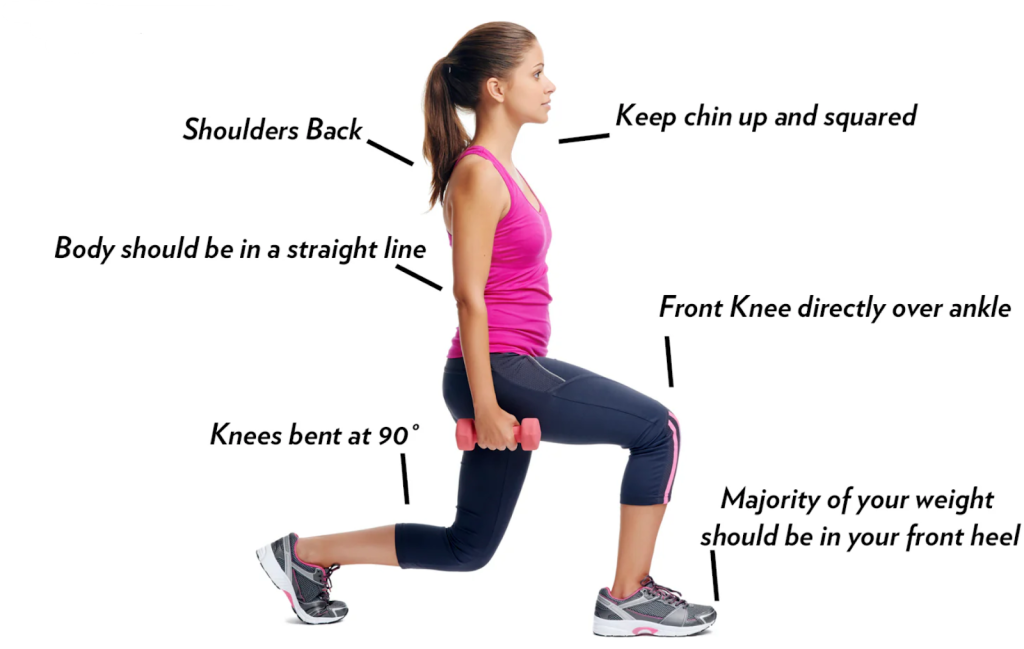
3 Reps Planks. Targets: core
Planks strengthen the core muscles that support the abdomen, spine and hips. A strong core can lower the risk of back pain and other problems.
- Lie on your stomach with your elbows tucked close to your sides directly underneath your shoulders, palms facing down.
- Push up with your arms, keeping your elbows and forearms connected to the floor while maintaining straight legs and torso so your back is flat.
- Hold this position for 30 seconds to one minute and then gradually lower to the floor.
For a simpler modification and more support, keep your knees and forearms on the floor.
Video: https://youtube.com/shorts/9j8-dM55J0M?si=uEKJrviIOSEKa5Nn
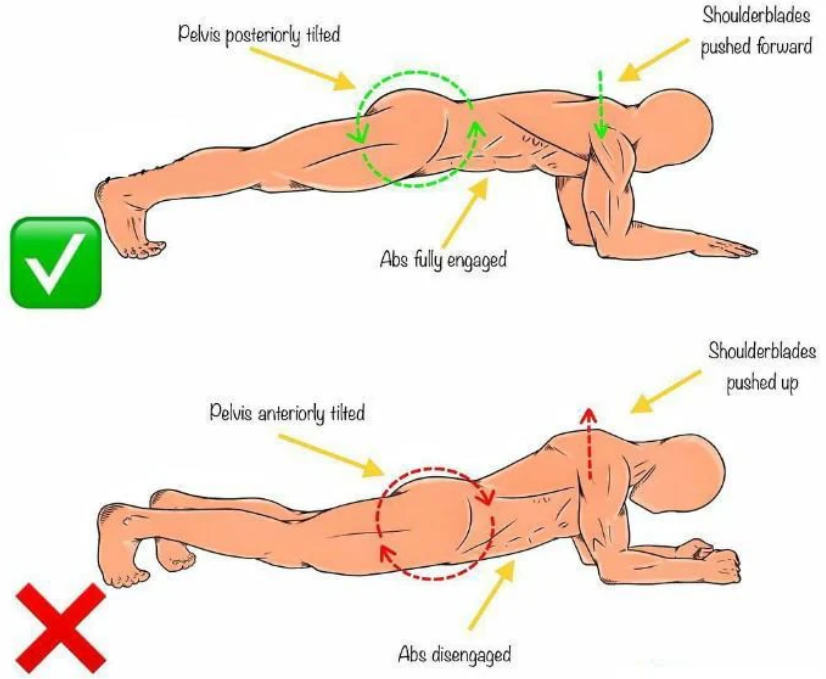
10 Reps Lunges
Lunges work the muscles in the butt and hips (“glutes”), thighs (quadriceps and hamstrings) and abdominals.
- Stand with your feet hip-width apart, hands on your hips or arms straight down by your side.
- Keep your back straight and take a step with your right leg. Bend your knees. Your left knee should point down toward the floor, while your right knee should be directly above your foot.
- Use the muscles in your right (forward) leg to push up and bring your right foot back to meet your left foot until you’re back in a standing position.
For a simpler challenge, do reverse lunges by stepping backward instead.
For an added boost, jump up vertically between each lunge as you alternate legs.
Video: https://youtube.com/shorts/1cS-6KsJW9g?si=7J3QDWwnIR_0GX6m
15 Reps Squats
Squats work the entire lower body from the abs down, including the calf muscles and shins. Studies show that squats are one of the few types of exercises that can increase bone mineral density in people who already have osteoporosis. They’re high-intensity, high-impact, weight-bearing exercises.
- Stand with your feet slightly wider than hip-width apart, toes slightly outward and arms down by your side.
- Shift your weight into your heels and brace your core (chest out, back straight).
- Inhale and lower your hips and butt toward the floor. Stop when your thighs are parallel (or almost parallel) to the floor.
- Evenly distribute your body weight between the balls and heels of your feet and keep your head facing forward, while trying not to lift your heels off the floor.
- Push off through your feet while keeping them flat on the floor, knees aligned over the second toes, until you return to a standing position.
For extra support, hold on to a chair, countertop or other firm surface while squatting or practice moving from a sitting position to a standing position, using only your arms for balance.
For an extra challenge, jump into the air from the squat position.
Video: https://youtube.com/shorts/PlDqgNcJJ2U?si=sgggVNEQnT-gf9Ki

15 Reps Push-ups
Push-ups work the upper body muscles in the arms (biceps), chest (pectorals), and shoulder muscles.
- Kneel on all fours on the floor, palms flat on the floor, fingers facing forward, hands shoulder-width apart and shoulders over your hands.
- For a simpler push-up, keep your knees bent on the floor.
- For a more challenging, full-body push-up, lift your knees off the floor and straighten your legs.
- Bend your elbows and slowly lower your body until your chest or chin touches the floor. While lowering, keep your head and abdomen in line with your spine and your elbows close to your sides so you maintain a flat back (similar to the plank position).
- Press up through the palm of your hands until your elbows fully extend. While raising your body, keep your head, abdomen and spine in a straight line. Don’t let your hips or back sag.
If doing push-ups on the floor is too difficult, you can do them while standing in the upright position, pushing off of a wall or other secured surface like a desk or table.
For an even harder challenge, clap your hands together after pushing up from the floor.
Video: https://youtube.com/shorts/zRer1WCWaEw?si=V5pOxITodJC_w-a5


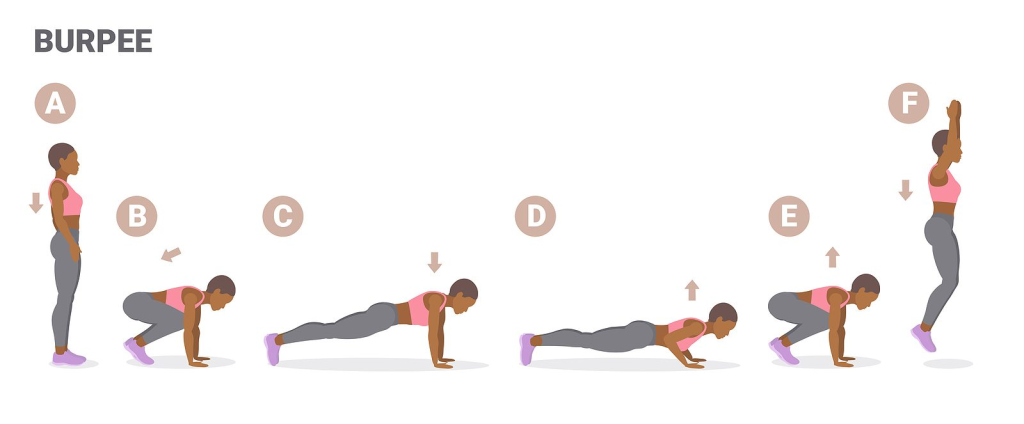
10 Reps Burpees
Burpees work the muscles from head to toe, incorporating different types of calisthenics exercises like squats, planks and push-ups in one flowing series. In addition to building muscle, burpees get the heart rate up to provide a great cardio workout.
- Stand with your feet hip-width apart, back straight, chest out and arms down at your sides.
- Drop into a squat, bending your knees and bringing your butt down.
- Keep your feet flat on the floor and place your hands palms down in front of your feet.
- Kick your legs straight back to immediately go into a plank position.
- Bend your elbows and lower your body toward the floor like you’re doing a push-up.
- Straighten your arms, so you’re back in a plank position.
- Return to a squat position by jumping your legs forward, landing with your feet flat on the floor near your hands.
- Push off with your legs and jump with your arms extended toward the ceiling. Land with your feet hip-width apart and repeat.
If you’re a beginner, you might want to skip the push-up and place your hands on a chair to perform the plank.
For a harder challenge, do a knee tuck, jumping into the air and tucking your knees after each push-up.
Video: https://youtube.com/shorts/RevoEOa_Esw?si=yhR2E_L5iIULEhSx
Deadlift. Targets: hamstrings and glutes
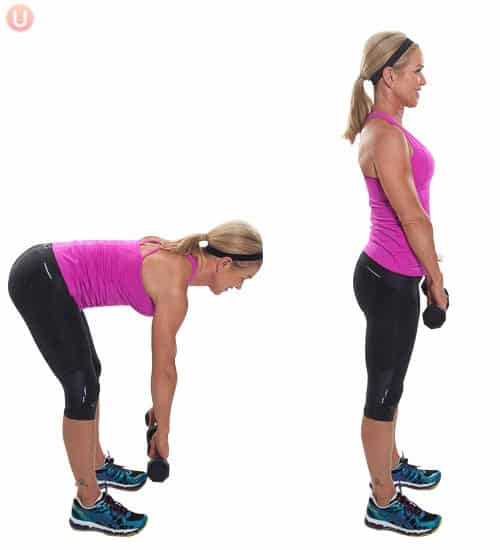
The deadlift is a compound weightlifting exercise that engages muscles throughout your body, especially targeting your hamstrings and glutes. Good form is key to keeping it from going into your lower back.
Start standing with feet hip-distance apart and then dumbbells resting in front of thighs.
Tighten your abdominals and keep a flat back as you bend the knees slightly, lowering the dumbbells towards the floor.
Squeeze the glutes and use your hamstrings and legs to lift and return to your upright position.
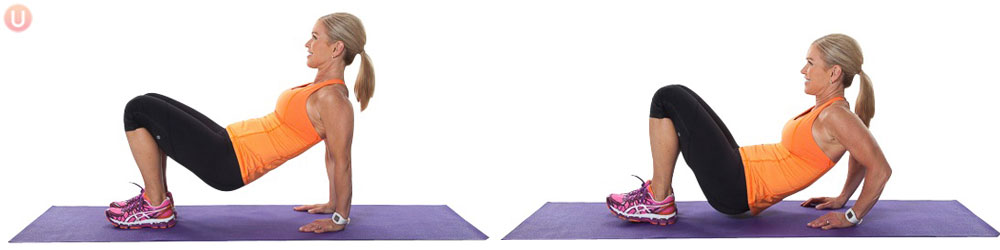
Tricep Dips. Targets: triceps and deltoids,
Start seated with knees bent and feet on the floor. Place hands behind you, directly under the shoulders, with finger facing your hips.
Lift hips to a hover.
Bend your elbow straight back and use your triceps to press back up.
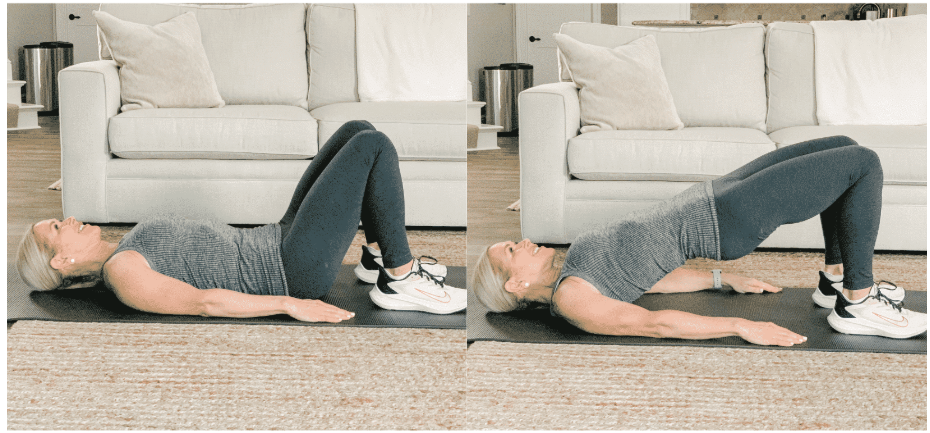
10 Reps Bridges Targets: hamstrings and glutes
This move targets your hamstrings and gluteal muscles (aka glutes). To do them, lie flat on your back with your knees bent upward and your feet on the floor. Then, lift your pelvis in the air and briefly hold your position before lowering your pelvis to the floor. That’s one rep.
Video: https://youtube.com/shorts/R1OXPHRqehw?si=lcp76_0jSGUlLNJd
Three variations of Bridges:

Single-Leg Hamstring Bridge (Left Side). Targets: hamstrings and glutes
Lie on back with bent knees hip-distance apart, and feet flat on mat stacked under the knees. Extend one leg long towards the ceiling.
Squeeze glutes and lift hips off the mat into a bridge. Lower and lift the hips for the desired number of reps then repeat on another side.

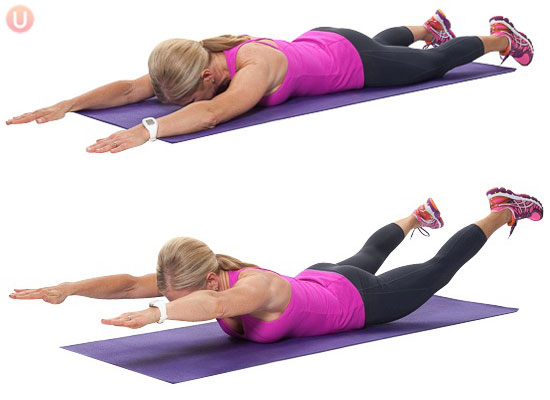
Superman. Targets: Lower back
Lie down on stomach with arms and legs long. Draw abdominals up and away from the mat and pull shoulders down away from ears.
Squeeze abs, back muscles and glutes to lift arms and legs off the mat. Release to start position with control.
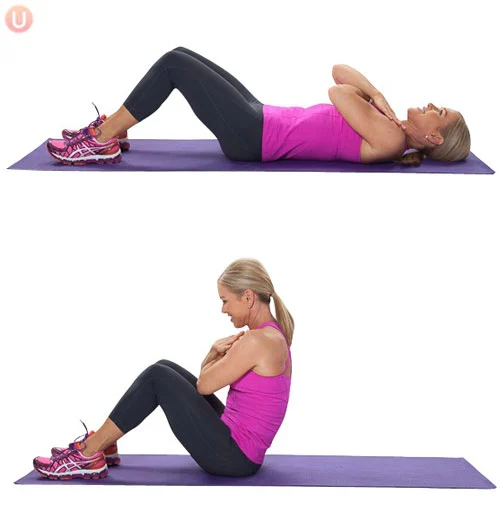
Full Sit-Up. Targets: upper and lower abs.
Start with knees bent and feet on the mat. Arms are crossed and resting on the chest.
Bring chin to chest and flex, the head, neck, and torso off the mat coming to a seated position then return back down with control.